Dog Training in Aurora: Classes, Costs and How to Choose a Trainer
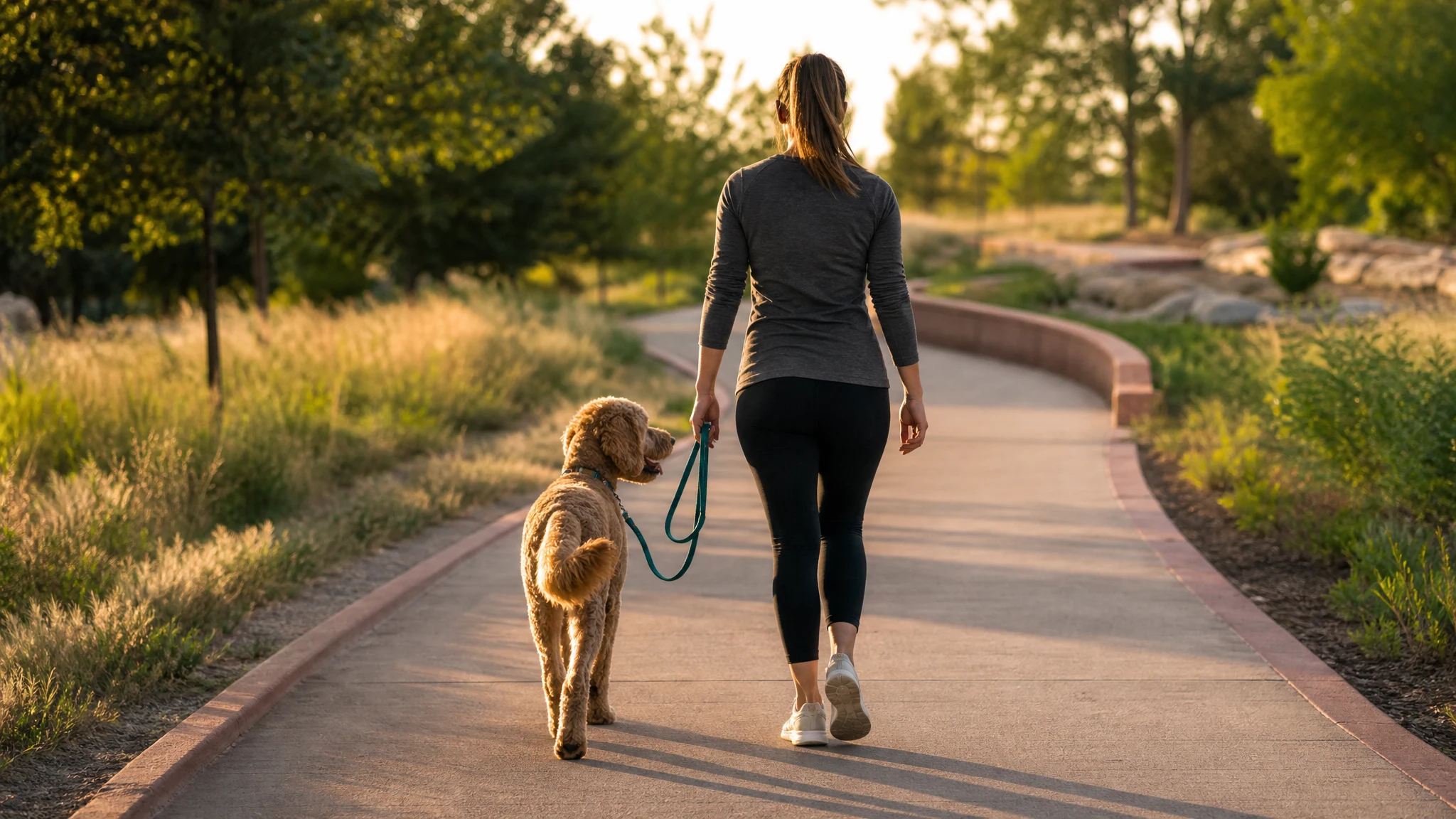
General training information. For aggression, sudden behavior changes or health concerns, see your veterinarian first.
Aurora is a big, spread-out city. It touches Arapahoe, Adams and Douglas counties, and it has everything from fenced neighborhood dog areas to the open space around Cherry Creek State Park. That mix shapes how you train. A dog who is calm in your living room in the 80014 zip code still has to handle a busy trail, a shared dog park and the rules that apply when you leave your property.
This guide walks through dog training in Aurora from start to finish. You will see the main kinds of training, what reward-based training means and why veterinary behavior experts recommend it, how to read a trainer's credentials, what to ask about cost, and which local rules and places matter once class is over.
Key Takeaways
- Aurora dog owners can choose group classes, private lessons, day training or board-and-train. Each suits a different dog and a different goal.
- Reward-based training is the approach the American Veterinary Society of Animal Behavior (AVSAB) recommends. Avoid any trainer who uses shock, prong or choke collars, alpha rolls or scruffing.
- The Certified Professional Dog Trainer directory (CCPDT) lists several CPDT-KA trainers with Aurora addresses. Credentials are a starting point, not a guarantee of a good fit.
- We found no published training prices for Aurora. Ask every trainer for a written fee breakdown before you commit.
- Off its property, your dog must be on a leash no longer than 10 feet, per City of Aurora Animal Services. Dogs over 6 months need a city license and current rabies vaccination.
- For aggression toward people or any sudden behavior change, see your veterinarian first and then a certified behavior professional.
Table of Contents
- The Kinds of Dog Training Available in Aurora
- What Reward-Based Training Is and Why the AVSAB Recommends It
- Certified Dog Trainers in Aurora
- Costs: What to Expect and What to Ask
- Aurora Rules That Shape Your Training
- Places to Practice in Aurora
- How to Choose a Trainer and Get Started
The Kinds of Dog Training Available in Aurora
Most dog trainers offer a few formats. The right one depends on your dog's age, your goals and how your household runs. Here is how the main options compare.
| Format | How it works | Often a good fit for |
|---|---|---|
| Group class | Several dogs and owners learn together over a set number of weeks. | Puppies and social dogs who need practice focusing around other dogs |
| Private lessons | One trainer works with you and your dog, often at your home or in a quiet setting. | Specific problems, busy schedules, shy or reactive dogs |
| Day training | A trainer works with your dog during the day, then coaches you on how to keep it up. | Owners who want a head start on basics |
| Board-and-train | Your dog stays with the trainer for a period of time. | Owners who want intensive work, with careful vetting |
Group classes
Group classes are the usual starting point for dog obedience training in Aurora. You learn skills like sit, down, come, loose-leash walking and settling on a mat, and you practice them around real-world distractions. They also teach you timing and handling, which matters as much as anything your dog learns.
A group setting can be too much for some dogs. If your dog barks, lunges or shuts down around other dogs, a private lesson may be a kinder first step.
Private lessons
Private sessions let a trainer look at your actual problem in your actual environment. If your dog pulls on the sidewalk outside your apartment or fusses when guests arrive, the trainer can work on that spot. Private work costs more per session in many places, but you may need fewer sessions because the plan is built around your dog.
Day training
In day training, the trainer works with your dog while you are at work or busy, then shows you how to keep the skills going. The handoff is the important part. A dog who behaves for the trainer but not for you has not finished learning. Ask how many coaching sessions are included for you.
Board-and-train
Board-and-train programs keep your dog with a trainer for a stretch of time. They appeal to people with little time, but they carry the biggest questions. Ask exactly what methods are used, who cares for your dog overnight, how many dogs are in the home or facility, and how you will be taught to carry the work forward. Ask for a visit or a video update. Walk away if the answers are vague or if the trainer will not describe their tools and methods.
What Reward-Based Training Is and Why the AVSAB Recommends It
Reward-based training means you teach your dog what to do and then pay for it. The pay can be a small food treat, a toy, a game, praise or access to something the dog wants, like a sniff or a walk forward. Behaviors that are rewarded tend to happen more often. You set the dog up to succeed, you mark the moment it gets it right, and you reward.
The American Veterinary Society of Animal Behavior (AVSAB) recommends reward-based methods. Its position is that aversive training, which relies on pain, fear or intimidation, can increase stress and anxiety and can damage the bond between dog and owner. AVSAB also cautions against using dominance theory to explain or fix behavior.
What this looks like in a good class
- Treats, toys and praise are used freely, and the trainer explains how to fade treats over time.
- Mistakes are met with a reset or a simpler step, not a correction.
- Lessons are broken into small, achievable pieces.
- Dogs are given breaks, and stressed dogs are allowed more distance.
- Equipment is a flat collar or a well-fitted harness and a leash.
Red flags to avoid
Do not hire a trainer who recommends or uses any of the following:
- Shock (electronic) collars
- Prong or pinch collars
- Choke chains
- Alpha rolls, scruffing or pinning a dog down
- Language about "being the pack leader" or "showing the dog who is boss"
Be cautious about any promise of quick, total fixes. Behavior takes repetition, and every dog learns at its own pace. Good trainers talk about progress and practice, not miracles.
Certified Dog Trainers in Aurora
Dog training is not a licensed profession in most places, so anyone can call themselves a trainer. One way to narrow the field is to look for independent certification. The Certification Council for Professional Dog Trainers (CCPDT) keeps a public directory of certified trainers. The credential in these listings, CPDT-KA, stands for Certified Professional Dog Trainer, Knowledge Assessed.
The CCPDT directory lists the following trainers with Aurora, Colorado locations. We are describing only what the directory shows. This is not a ranking or a recommendation, and we have not reviewed or worked with any of them.
- Jennifer R. Fantasia of Happy Hounds Dog Training. CPDT-KA, MA. Listed in Aurora, CO 80014. The trainer's own site also mentions Denver, Centennial, Cherry Creek and other nearby areas. Website: happyhoundsdogtraining.us. CCPDT profile.
- Patricia J. Blocker of Peaceful Paws Dog Training. CPDT-KA. Listed in Aurora, CO 80010. Website: peacefulpaws.net. CCPDT profile.
- Erin Michelle Lukacovic. CPDT-KA. Listed in Aurora, CO 80013. The directory profile does not state a business name, and the listed website is elevationbehavior.com. CCPDT profile.
- Charleen M. Cordo. CPDT-KA. Listed in Aurora, CO 80015. The profile lists no business name and says she is a satellite trainer for Pets for Vets. CCPDT profile.
- Desirae Evelyn Audino. CPDT-KA. Listed in Aurora, CO, with no zip code shown. CCPDT profile.
Directory listings change, so confirm each trainer's current status, services and service area directly. Contact details, class schedules and fees are not in the directory entries we relied on, so ask the trainer.
What a credential does and does not tell you
A certification shows that a trainer has passed an assessment of knowledge. It does not tell you how well that person works with a nervous dog, a large dog or a first-time owner. It also does not replace your own questions about methods. Use the credential as one step, then talk to the trainer.
Other help beyond training
The directory above covers dog trainers. If your dog has aggression toward people, severe fear or a sudden change in behavior, you need a veterinarian and a certified behavior professional, not only a trainer. We do not have a verified list of behavior professionals in Aurora, so ask your veterinarian for a referral.
Costs: What to Expect and What to Ask
We did not find published training prices for Aurora trainers, so we will not quote a number. Fees vary with the format, the length of the program and the trainer's experience. Check each trainer's website or call to get current pricing.
Questions that make costs clear
- What is the total cost, and what does it include?
- How many sessions or weeks are in the program, and how long is each session?
- Is there a separate fee for an evaluation or intake call?
- What happens if we miss a class or need to reschedule?
- Are treats, equipment or materials included?
- What vaccinations does my dog need before starting?
- Is there a refund or make-up policy if the program does not fit my dog?
Ask for the answers in writing. Be wary of any trainer who pressures you to pay in full on the spot or who will not explain what happens during a session.
Other costs to plan for in Aurora
Training is not the only expense. According to City of Aurora Animal Services, all dogs and cats over 6 months must be licensed through the Aurora Animal Shelter. For a spayed or neutered dog, the license is $15 for 1 year or $41 for 3 years. Residents 65 or older get a 50 percent discount with proof of age. For a dog that is not spayed or neutered, the license is $53 for 1 year or $156 for 3 years, with no discount. A current rabies certificate is required.
If you plan to use the off-leash area at Cherry Creek State Park, Colorado Parks and Wildlife lists a Dog Off-leash Daily Pass at $3 and an Annual Pass at $25. A park entrance pass is also required for vehicles. Fees can change, so check the CPW page before you go.
Aurora Rules That Shape Your Training
Good training works with local rules, not against them. These are the ones that come up most for Aurora dog owners.
Leash rules
City of Aurora Animal Services says a dog off its owner's property must be on a leash no longer than 10 feet, held by a person physically able to control it. For tethered dogs, the tether must be at least 6 feet long. This is why loose-leash walking is a core skill. A dog who pulls hard can be difficult to control, and your leash skills need to match the dog you have.
Licensing and rabies
Per City of Aurora Animal Services, dogs 6 months and older living in city limits must be current on rabies vaccination, and expired rabies certificates are not accepted for licensing. Tell your trainer that your dog's vaccinations are up to date, and ask what they require before class. For puppy vaccine timing, talk to your veterinarian.
Number of dogs
City of Aurora Animal Services lists a limit of four dogs per household. The limit applies to the entire household. If you are adding a second or third dog, plan for training each one separately before you work on them together.
Barking
Barking is one of the most common reasons owners look for help. We could not confirm the current city rule on barking complaints, so contact Aurora Animal Services to ask how nuisance barking is handled. A trainer can help you find out why your dog barks and teach an alternative behavior. That tends to work better than trying to simply stop the noise.
Dangerous dog rules and breed
City of Aurora Animal Services says the City Council enacted a new dangerous-dog ordinance that lets judges decide, based on a dog's behavior and actions, whether a dog of any breed poses a risk to the community. The city also states that since January 2025, residents may own American Pit Bull Terriers, American Staffordshire Terriers and Staffordshire Bull Terriers, and these dogs must be licensed.
The practical point for owners is that behavior is what counts. Training, socialization and good management help, and a dog who is reliable on a leash and calm around people is easier to keep safe. For details on the process, check the city's Animal Services pages or call them.
Which county are you in?
Aurora spans Arapahoe, Adams and Douglas counties. Some rules may differ depending on your address, so confirm anything specific with the city or your county.
Places to Practice in Aurora
Class teaches the skill. Real life is where it sticks. These are the off-leash and dog-friendly spots listed for Aurora.
Cherry Creek State Park Dog Off-Leash Area
Cherry Creek State Park is run by Colorado Parks and Wildlife, not the city. CPW says dogs must stay within visual distance and under voice control, and each handler may bring up to three dogs. You must carry a leash and a waste bag for each dog, and dogs must be leashed outside the off-leash area. CPW notes that the area is not fully fenced. That makes a reliable recall important before you let your dog loose.
CPW's page also lists a short closure in late October, with reopening on October 31. Check the page for current dates before you visit.
City dog parks
Visit Aurora, the city's tourism site, lists these dog areas:
- Grandview Dog Park, 17500 E Quincy Ave, Aurora, CO 80015, next to Quincy Reservoir. Free. About 5 acres with separate fenced areas for large and small dogs, an agility course and seasonal water access.
- Bicentennial Park Off-Leash Area, 13600 E Bayaud Ave, Aurora, CO 80012. A fenced area of about 1 acre with grass and dirt, waste stations and benches. Open daily, dawn to dusk.
- Singletree Park Dog Area, 19590 E 58th Ave, Aurora, CO 80019. Free. A fully fenced off-leash section of about 0.34 acres, open dawn to dusk.
Hours and conditions can change, so confirm with the city or Visit Aurora before you go.
Using dog parks wisely
A dog park is not a training class. Practice a few things first:
- A reliable recall in distracting settings
- Calm greetings on leash
- Leaving a toy, a treat or another dog when asked
Watch your dog's body language. If your dog hides, stiffens or tries to leave, take a break. Small and large dog sections exist for a reason, so use them.
Water safety
Reservoirs are tempting on a warm day, but they carry a risk. The Denver Gazette reported a warning from the Colorado Department of Public Health and Environment that toxic blue-green algae blooms can kill pets, particularly dogs. Toxins were detected at Cherry Creek Reservoir in 2022. Before letting your dog near any reservoir, check current advisories from Colorado Parks and Wildlife and the state health department. If your dog swims and then vomits, seems weak or acts unusual, contact a veterinarian right away.
How to Choose a Trainer and Get Started
Step 1: Define your goal
Write down what you want. It might be basic dog obedience training in Aurora for a new puppy, a calmer walk down your street, a solid recall for the off-leash area, or help with a specific problem like jumping, barking or fear of strangers. A clear goal helps a trainer suggest the right format.
Step 2: Rule out medical causes
Pain, illness and sudden changes can drive behavior. If your dog has started acting differently, see your veterinarian before you pay for training. In any emergency, go to a veterinarian right away.
Step 3: Check credentials and methods
Start with the CCPDT directory, and look for trainers who are open about their methods. Ask them directly: "What happens when my dog gets something wrong?" The answer should describe resetting, redirecting and rewarding, not corrections, pain or fear.
Step 4: Observe or talk first
Ask to watch part of a class or to have a short call before you enroll. Look for relaxed dogs, happy owners and a trainer who explains things clearly. Notice how the trainer treats a dog who is struggling.
Step 5: Ask about fit
Questions worth asking:
- How many dogs are in each class?
- What experience do you have with my dog's age, size or issue?
- What tools and equipment do you use?
- What will I practice at home between sessions?
- What do you do if a dog is too stressed to continue?
Step 6: Practice daily
Short sessions of a few minutes, a few times a day, usually beat one long session. Start in a quiet room, then move to the yard, then to a quiet street, then to a park. Raise the difficulty slowly, and go back a step when your dog struggles.
When to get more help
If your dog growls, snaps or bites people, or you feel unsafe, contact your veterinarian and a certified behavior professional. Do not try to fix aggression on your own, and do not use punishment. It can make things worse.
Adopting from the Aurora Animal Shelter
If you are adding a dog, the Aurora Animal Shelter at 15750 E. 32nd Ave., Aurora, CO 80011 is the city's municipal shelter. You can reach it at 303.326.8280. Newly adopted dogs often need time to settle, so give them a few quiet weeks to learn your routine before you ask for much. Then start with the basics.
Final Thoughts
Training a dog in Aurora is easier when you pick a format that fits your dog, choose a trainer who uses reward-based methods, and know the local rules before you head out the door. Start small, stay patient and celebrate progress. Every dog learns at its own speed, and the time you put in builds trust that lasts.
Sources
- City of Aurora Animal Services, Dog Basics
- City of Aurora Animal Services, Licenses
- City of Aurora Animal Services, Prohibited Dog Breeds
- City of Aurora Animal Services, Aurora Animal Shelter
- Colorado Parks and Wildlife, Cherry Creek State Park Dog Off-Leash Area
- Visit Aurora, Dog Parks
- CCPDT Certified Dog Trainer Directory, Jennifer R. Fantasia
- CCPDT Certified Dog Trainer Directory, Patricia J. Blocker
- CCPDT Certified Dog Trainer Directory, Erin Michelle Lukacovic
- CCPDT Certified Dog Trainer Directory, Charleen M. Cordo
- CCPDT Certified Dog Trainer Directory, Desirae Evelyn Audino
- Denver Gazette, reporting a Colorado Department of Public Health and Environment warning on toxic algae