Help for a Reactive or Aggressive Dog in Aurora
General training information. For aggression, sudden behavior changes or health concerns, see your veterinarian first.
If your dog lunges, barks, or snarls at other dogs, strangers, or bikes, you are not alone, and you are not a bad owner. Many Aurora households live with this, and it is workable with patience, good management, and the right support.
This guide explains what reactivity and aggression are, how to keep everyone safe, and how reactive dog training works at home using humane, reward-based methods. It also covers Aurora's leash rule, the city's dangerous dog ordinance, and where to look for local help.
What reactivity and aggression actually are
A reactive dog overreacts to a trigger. Common triggers are other dogs, unfamiliar people, children, bikes, skateboards, or sudden noises. The reaction can look like barking, lunging, growling, or freezing and staring.
Most reactivity comes from big feelings: fear, frustration, or overexcitement. A leash often makes it worse, because the dog cannot move away from what scares or thrills it.
Aggression is behavior meant to create distance or cause harm, such as snapping, biting, or a hard stare with a stiff body. Reactivity can slide toward aggression if the dog learns that big displays make scary things go away.
You cannot always tell the two apart from the outside. That is one reason professional help matters, and it is why this page is a starting point, not a replacement for an in-person evaluation.
Safety first
Before any training, make your daily life safer. Management prevents rehearsal of the behavior, and every rehearsal makes the habit stronger.
- Keep your dog on a secure leash and well-fitted harness or flat collar on every outing.
- Avoid crowded places, busy trails, and dog parks while you work on this.
- Use baby gates, closed doors, or a crate when guests visit.
- Never leave a dog with a bite history unsupervised with children or visitors.
- Learn the early warning signs: stiff body, hard stare, lip lifts, whale eye (showing the whites), and growling. A growl is communication. Do not punish it.
If your dog has bitten or seriously threatened a person, skip ahead to the section on professional help and call your veterinarian first.
Aurora rules you should know
City of Aurora Animal Services says a dog off its owner's property must be on a leash no longer than 10 feet, held by a person physically able to control it. A reactive dog needs this even more than most. Choose a handler who can truly hold the dog, and skip retractable leashes that make distance hard to judge.
Aurora also has a dangerous dog ordinance. According to City of Aurora Animal Services, the City Council enacted a new ordinance that gives judges latitude to decide, based on a dog's behavior and actions, whether a dog of any breed poses a risk to the community. In other words, the focus is on what an individual dog does, not its breed.
The practical meaning for you is simple. A dog that bites or repeatedly threatens people or other animals could end up in front of a municipal judge. For the exact process and possible conditions, contact Aurora Animal Services directly rather than relying on a summary.
Also remember that Aurora Animal Services requires dogs over 6 months to be licensed and to have a current rabies certificate. Keeping paperwork current is one less problem if an incident ever happens. Aurora spans parts of Arapahoe, Adams, and Douglas counties, so check with the agency if you are unsure which rules apply at your address.
Why punishment makes it worse
The American Veterinary Society of Animal Behavior (AVSAB) advises that aversive training, including shock, prong, and choke collars, yelling, and physical corrections, can increase fear and aggression. It also advises that reward-based methods should be the standard for behavior problems.
Here is why that matters for a reactive dog. If your dog lunges at another dog and gets a leash jerk, the dog learns that other dogs predict pain. The next reaction can be bigger, or the dog may stop warning you and go straight to biting.
Skip alpha rolls, scruffing, and "showing the dog who is boss." They add fear to a dog who is already struggling.
How to work on reactivity at home: step by step
Materials you will need
- A well-fitted harness or flat collar and a 4 to 6 foot leash (within Aurora's 10 foot limit)
- Small, soft, high-value treats your dog loves, such as tiny pieces of cooked chicken or cheese
- A treat pouch you can reach quickly
- A quiet place to practice, with room to create distance
- A notebook to track triggers, distances, and progress
- A helper with a calm, leashed, well-behaved dog, if you can arrange one (optional)
Step 1: See a veterinarian
Pain, thyroid problems, and other medical issues can drive sudden changes in behavior. Book a checkup first and describe exactly what you are seeing. Ask whether your dog's behavior could have a medical cause and whether a referral makes sense.
Step 2: Find your dog's threshold
The threshold is the distance at which your dog notices a trigger but can still take a treat and respond to you. Over threshold, your dog cannot learn. Under it, your dog can.
Watch your dog's body. Loose and curious is good. Stiff, fixed, or barking means you are too close. Write down the distance in your notebook.
Step 3: Teach a few easy skills in a calm place
Practice these at home first, with no triggers around:
- Name response: Say your dog's name, then reward when they look at you.
- Hand target: Present your open palm and reward your dog for touching it with their nose. This gives you a way to move your dog away from trouble.
- "Let's go" U-turn: Cheerfully say "let's go," turn, and walk away while treating along the way.
Keep sessions to a few minutes and end on a win.
Step 4: Start counter-conditioning
Counter-conditioning changes how your dog feels about a trigger. The pattern is easy: trigger appears, treat arrives. Over many repetitions, the trigger can start to predict good things instead of danger.
Stay under threshold. The moment your dog sees the trigger, begin feeding small treats. When the trigger disappears, the treats stop. This is not bribing. The treat is changing the dog's emotional response, which is what drives the behavior.
Step 5: Add desensitization gradually
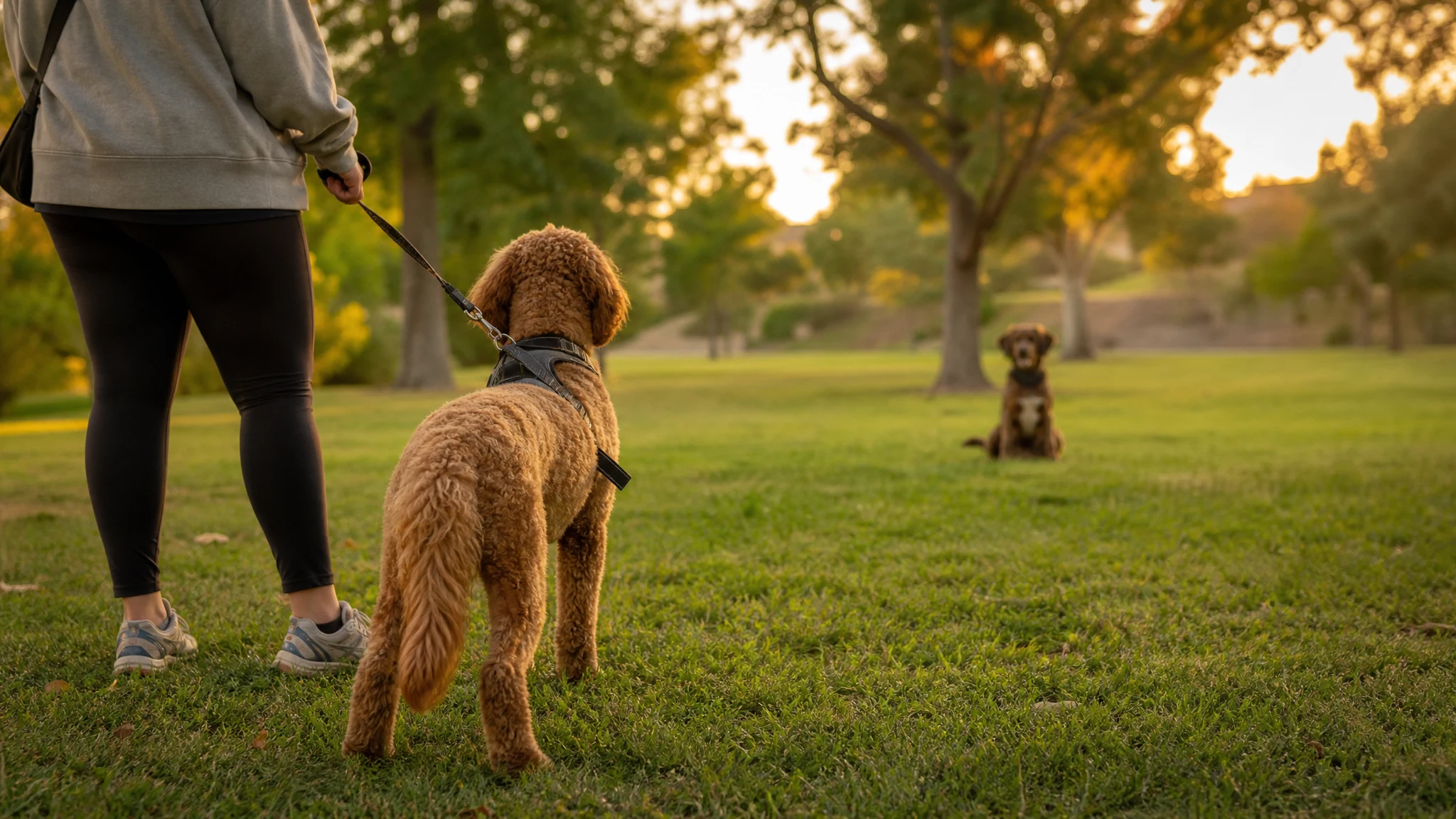
Desensitization means exposing your dog to the trigger at a level so low that it does not cause a reaction, then slowly increasing the intensity. For a dog who reacts to other dogs, that might mean watching a calm dog from across a wide field, then later from a little closer.
Change only one thing at a time: distance, movement, or duration. If your dog starts reacting, you moved too fast. Increase the distance and try again.
Step 6: Practice on walks with an exit plan
Pick quiet times and wide-open spaces so you have room to turn. Cross the street or make a U-turn when you see a trigger approaching before your dog reacts. Walking away is not failure. It protects your dog's progress.
If you meet a surprise trigger, stay calm, turn away, and feed treats as you move off. A loose, steady leash tells your dog you have the situation handled.
Step 7: Track progress and keep sessions short
Note how close your dog can get, how quickly they recover, and how often they look to you. Progress is rarely a straight line. Bad days happen, and they do not erase earlier work.
Tips and common mistakes
- Going too close, too soon. This is the most common mistake. Distance is your best tool.
- Using forced meet-and-greets. "Let them work it out" can make fear worse. Let your dog watch from a distance instead.
- Using dog parks as therapy. Off-leash areas are unpredictable. A reactive dog is usually better off skipping them for now.
- Tight leashes. A tense leash can add to tension. Practice relaxed handling.
- Expecting fast change. Reactivity often takes weeks to months of steady practice.
- Skipping exercise and enrichment. Sniff walks, food puzzles, and chew time can help a stressed dog settle.
Be careful around water as well. The Denver Gazette, reporting a warning from the Colorado Department of Public Health and Environment, said toxic blue-green algae blooms can kill pets, especially dogs, and toxins were detected at Cherry Creek Reservoir in 2022. A calm walk is not worth a risk like that, so check current advisories from Colorado Parks and Wildlife and the state health department before letting a dog near reservoir water.
When to see a veterinarian or veterinary behaviorist
Call your veterinarian promptly if the behavior appeared suddenly, got worse quickly, or comes with signs of pain, changes in appetite or sleep, or confusion. Medical and behavior emergencies need a veterinarian, not a training plan.
If your dog has bitten or tried to bite a person, or if the aggression is intense or unpredictable, involve both a veterinarian and a certified behavior professional. Ask your veterinarian whether a referral to a veterinary behaviorist is appropriate. A veterinary behaviorist is a veterinarian with advanced training in behavior who can evaluate medical factors and discuss treatment options, including medication when it is appropriate.
We do not have a verified local list of veterinary behaviorists for Aurora, so ask your own veterinarian for a referral.
Local trainers in Aurora
The Certification Council for Professional Dog Trainers (CCPDT) lists the following Aurora-area trainers with the CPDT-KA credential (Certified Professional Dog Trainer, Knowledge Assessed). Each name links to the trainer's CCPDT directory profile. Listing a trainer here is not a recommendation, and a credential does not tell you whether someone works with reactive or aggressive dogs, so ask about experience before you book.
- Jennifer R. Fantasia, Happy Hounds Dog Training, Aurora 80014. Her site also lists Denver, Centennial, Cherry Creek, and other nearby areas.
- Charleen M. Cordo, Aurora 80015. The profile says satellite trainer for Pets for Vets.
- Patricia J. Blocker, Peaceful Paws Dog Training, Aurora 80010.
- Erin Michelle Lukacovic, Aurora 80013. Her website is elevationbehavior.com.
- Desirae Evelyn Audino, Aurora, CO.
Good questions to ask any trainer: What methods do you use? Do you avoid shock, prong, and choke collars? Have you worked with dogs like mine? What does a first session look like? A trainer who uses reward-based methods will be comfortable answering all of these.
For a broader look at how classes work, what to expect for cost, and how to choose a program, see our guide to dog training in Aurora: classes, costs, and how to choose. Group classes can be a poor fit for a dog who is actively reactive, so ask about private sessions or a reactive-dog format.
What results to expect
Many reactive dogs improve with consistent management, reward-based training, and time. Improvement might look like a shorter recovery after a trigger, more distance tolerated, or more check-ins with you. Some dogs may do well in many situations but still need ongoing management.
No one can promise how far a particular dog will progress. It depends on the dog's history, health, the trigger, and how consistently the plan is followed. Aim for steady progress, not perfection.
A note for the hard days
Living with a reactive or aggressive dog can be tiring and isolating. Celebrate small wins, like a calm look at a passing dog or a successful U-turn. If you feel overwhelmed or unsafe, reach out to your veterinarian and a certified professional. Asking for help is a sign of a committed owner.
If you ever need to surrender or rehome a dog for safety reasons, the Aurora Animal Shelter is located at 15750 E. 32nd Ave., Aurora, CO 80011, and its phone number is 303.326.8280. Be honest about the dog's history so the staff can make safe decisions.