Off-Leash Dog Parks in Aurora and How to Train for Them
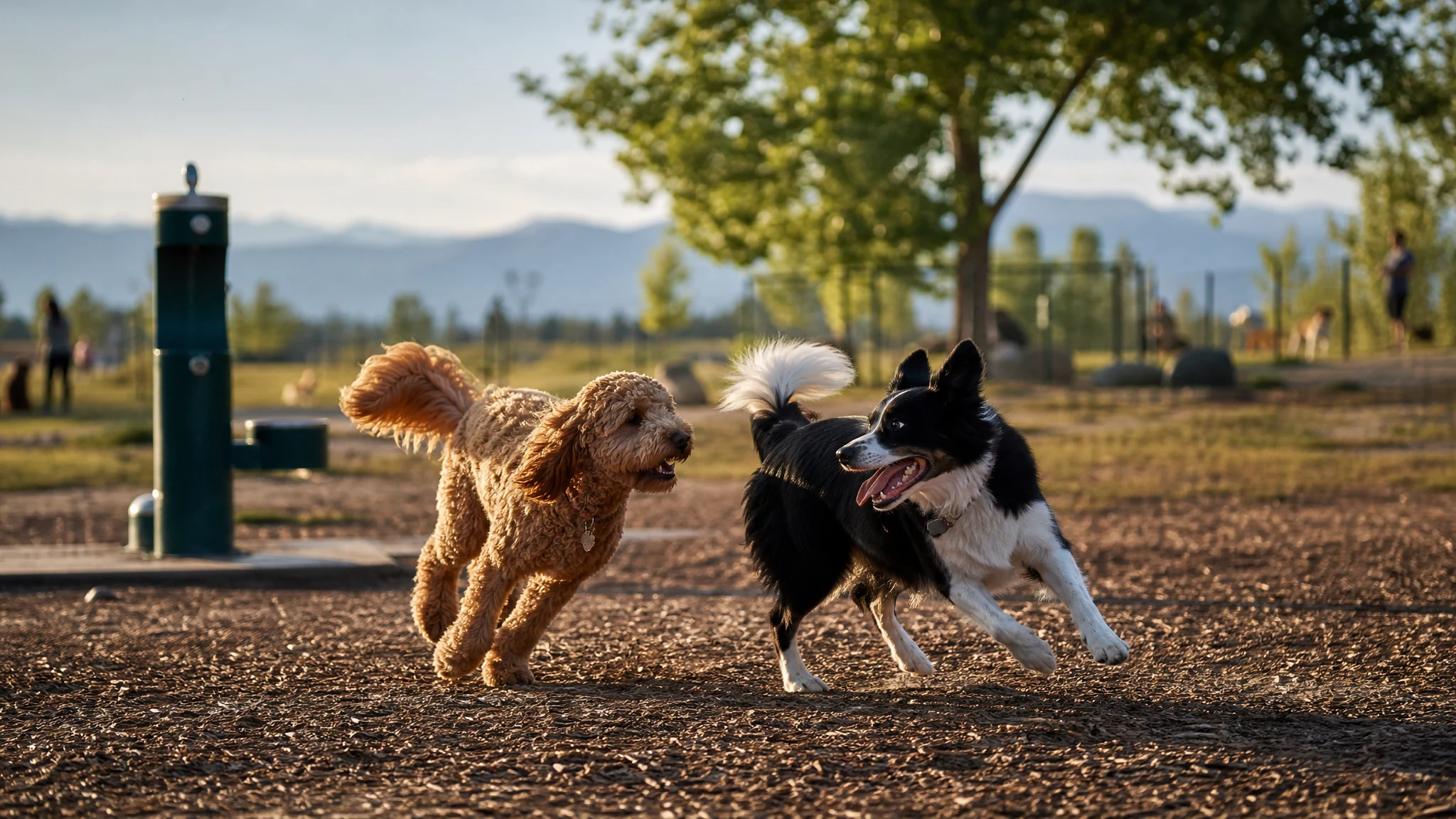
General training information. For aggression, sudden behavior changes or health concerns, see your veterinarian first.
Many dog parks in Aurora offer a good way to burn off energy. They also put your dog among strangers, new smells and a lot of excitement. A dog who loves the park on day one can still struggle if the basic skills are missing.
This guide covers the off leash dog parks Aurora owners can use, the rules posted for each, and a step-by-step plan for getting your dog ready. It ends with a frank look at when a dog park is not the right choice.
Dog Parks in Aurora: Where to Go and What the Rules Say
If you want an off leash dog park near Aurora neighborhoods, these four sites are the ones to know. Details come from Colorado Parks and Wildlife and from Visit Aurora, the city tourism site. Rules and hours can change, so check the source before you go.
Cherry Creek State Park Dog Off-Leash Area (DOLA)
This area sits inside Cherry Creek State Park. It is run by Colorado Parks and Wildlife (CPW), not the city. According to CPW:
- A Dog Off-leash Daily Pass costs $3 for one handler and up to three dogs.
- A Dog Off-leash Annual Pass costs $25 for one household handler and up to three dogs, for 12 months.
- A park entrance pass is also required for vehicles.
- The limit is three dogs per handler.
- Dogs must stay within visual distance and under voice control.
- You must carry a leash and a waste bag for each dog.
- Dogs must be on leash outside the off-leash area.
- CPW says the area is not fully fenced.
The CPW page also lists a closure from Oct. 26 to 30, with the area reopening Oct. 31. Check the page for current dates before you drive over.
Grandview Dog Park
Grandview is at 17500 E Quincy Ave, next to Quincy Reservoir. Visit Aurora describes it as free and about 5 acres. It has separate fenced areas for large and small dogs, an agility course and seasonal water access. Visit Aurora does not list hours, so check with the city before you plan a visit.
Bicentennial Park Off-Leash Area
Bicentennial Park is at 13600 E Bayaud Ave. Visit Aurora describes a fenced area of about 1 acre with grass and dirt, waste stations and benches. It is listed as open daily from dawn to dusk.
Singletree Park Dog Area
Singletree Park is at 19590 E 58th Ave. Visit Aurora lists it as free, with a fully fenced off-leash section of about 0.34 acres, open dawn to dusk. That is a small space, so it can feel crowded when several dogs arrive at once.
Rules that apply everywhere else
Outside these areas, City of Aurora Animal Services says a dog off its owner's property must be on a leash no longer than 10 feet, held by a person physically able to control it. The same page says all dogs and cats over 6 months must be licensed through the Aurora Animal Shelter. Dogs 6 months and older in city limits must be current on rabies vaccination. The licensing page says a current rabies certificate is required.
Animal Services also says a household may have four dogs. Aurora spans Arapahoe, Adams and Douglas counties, so ask the agency if you are unsure how a rule applies at your address.
Aurora also updated its dangerous-dog rules. According to City of Aurora Animal Services, judges can now decide based on a dog's behavior and actions, whatever the breed, whether the dog poses a risk. A fight or bite at a park is something you want to avoid for your dog's sake and for everyone else's. For the details of the process, read the city's page or call Animal Services.
What You Need Before You Start
Materials
- A flat collar or a well-fitted harness, and a standard 6-foot leash (the city allows up to 10 feet)
- A long line of 15 to 30 feet, made of lightweight cord, for recall practice
- Small, soft treats your dog loves, cut pea-sized so you can reward quickly
- A treat pouch that keeps treats easy to reach
- A waste bag for each dog
- Water and a collapsible bowl
- Your dog's current Aurora license tag and proof of rabies vaccination
Before the first visit
Ask your veterinarian whether your dog's vaccines and parasite prevention are right for shared spaces. Puppies need extra care, and your vet is the right person to say when a young dog is ready to be around unfamiliar dogs. Dogs that are not spayed or neutered, or that are very young, may also need special thought. Your vet can help there too.
Use only rewards and gentle guidance as you train. Shock, prong and choke collars, alpha rolls and scruffing are not part of this plan. The American Veterinary Society of Animal Behavior (AVSAB) recommends reward-based training, and it protects the trust your dog needs to come back to you in a busy place.
How to Train Your Dog for an Aurora Off-Leash Park
Give each step several short sessions over days or weeks. Move on only when your dog succeeds most of the time at the current level. Every dog learns at a different pace.
Step 1: Build a reliable recall
Recall is the skill that matters most. Cherry Creek requires voice control, and every other site asks you to be able to get your dog back.
- Pick one cue. Use a word such as "here" and say it in a happy voice. Never use it to call your dog for something unpleasant.
- Start indoors. Stand a few feet away, say the cue once, and reward the moment your dog reaches you. Repeat in different rooms.
- Go to the yard. Practice with the leash on, then with the long line trailing. Reward with a treat and a bit of praise.
- Add mild distractions. Practice during a walk when a bird lands or a neighbor passes. Use better treats as the distraction grows.
- Make it a party. Reward with several treats in a row at first, then sometimes with a game of tug or a favorite toy.
- Practice on the long line outdoors. Use a quiet field or the outside of a fenced park before you open the gate. If your dog ignores the cue, do not repeat it again and again. Gently reel in the line, then reward when your dog arrives.
Tip: Never scold a dog who comes back, even if the dog took too long. Your dog should always learn that returning to you is the best choice.
Step 2: Teach check-ins
A check-in is when your dog looks at you or walks to you on their own, then goes back to play. It keeps your dog connected to you in a busy space.
- On a walk, wait for your dog to glance your way. Mark it with a cheerful "yes" and give a treat.
- Repeat until your dog starts looking at you on purpose.
- Practice with the long line in a yard. Each time your dog turns toward you or comes close without a cue, reward and then release them to sniff again.
- Practice at the edge of a park while dogs play at a distance. Reward calm looks to you.
Dogs who check in often are easier to call back, and you will notice problems sooner.
Step 3: Practice calm greetings on leash
Many park problems start at the gate, where dogs rush in on top of each other.
- Walk past other dogs at a distance where yours can stay relaxed. Reward calm behavior.
- Move closer over several sessions. Keep the leash loose.
- With an owner you know, let the dogs greet for only a few seconds. Call yours away before they get too wound up.
- Reward your dog for turning toward you after the greeting.
A tight leash can raise tension. Keep it loose and relaxed when you can.
Step 4: Learn to read play
This step is for you, not your dog. Good play usually looks loose and bouncy. Watch for:
- Relaxed, wiggly bodies and open mouths
- Play bows and chasing that trades roles
- Pauses and breaks, where both dogs choose to keep going
Signs that a dog may be uncomfortable or that play is turning rough include:
- A stiff body, hard stare or frozen posture
- A tucked tail, cowering or hiding behind you
- One dog pinning or chasing another who keeps trying to leave
- Raised hackles, growling that gets more intense, or lunging
If you see these signs, calmly call your dog and leave the area or take a break. Do not wait for a fight to happen. If your dog repeatedly shows fear or aggression, skip the park and ask your vet for help.
Step 5: Practice leaving calmly
Leaving is hard when the fun is still going. Practice it early so it becomes normal.
- Visit for just a few minutes at first. Leave while your dog is still doing well.
- Call your dog with your recall cue. Clip on the leash and reward.
- Walk off with a treat in hand. Do not drag your dog away.
- Sometimes go back to play after the leash goes on, so leaving does not always mean the end of fun.
Many owners find that ending a visit early on a good note makes the next visit go better.
Step 6: Do a first visit at a quiet time
- Choose a time when few dogs are there. Check the hours posted for the park.
- Walk the perimeter on leash before you go in.
- Use the gate with care. A double-gate setup lets you unclip the leash in a calm space.
- Stay close and keep your attention on your dog, not your phone.
- Leave after 10 to 15 minutes, even if all goes well.
Common Mistakes to Avoid
- Skipping recall training. A dog who ignores your call is not ready for open space.
- Using the park to tire out an overexcited dog. A wound-up dog tends to make poor choices in a crowd.
- Bringing treats or toys that cause fights. Food and favorite toys can lead to guarding. Consider leaving them in the car unless your dog is calm around other dogs.
- Not watching the dog. Most trouble starts quietly. Stay near and stay alert.
- Ignoring the weather and water. Colorado Department of Public Health and Environment (CDPHE) warned in 2022, as reported by the Denver Gazette, that toxic blue-green algae blooms can kill pets, especially dogs. Toxins were detected at Cherry Creek Reservoir that year. Check current CPW and CDPHE advisories before letting your dog near any reservoir or pond.
- Forgetting the paperwork. Keep the license current and the rabies vaccine up to date.
What Results to Expect
With steady practice, many dogs get more reliable at coming when called and checking in during play. Progress depends on your dog's age, history, breed type and temperament, and on how often you practice. Some dogs take a few weeks. Others need months, and some may never be a good fit for off-leash play.
If you want help with recall or group manners, a class or private session can speed things up. Our guide to dog training in Aurora, including classes, costs and how to choose explains what to look for.
When a Dog Park Is Not Right for Your Dog
A dog park is optional, not a requirement for a happy dog. Consider skipping it, at least for now, if your dog:
- Is a young puppy who has not finished the vaccines your vet recommends
- Is fearful, shy or easily overwhelmed by new dogs
- Guards food, toys or you around other dogs
- Has snapped or fought with other dogs
- Is in heat, ill, injured or recovering from surgery
- Does not come back when called, even in a quiet yard
- Is an older or frail dog who may get hurt in rough play
Good alternatives include on-leash walks, sniff walks, a long line in a quiet field, fetch in a fenced yard, and one-on-one playdates with a dog you know and trust.
If your dog has shown aggression toward people, do not take them to a dog park. Talk with your veterinarian first, then work with a certified behavior professional. A sudden change in behavior can also point to pain or illness, so see your vet promptly in that case. If your dog is hurt in a fight or shows signs of heat stress or poisoning, treat it as an emergency and contact a veterinarian right away.
Quick Checklist Before You Go
- Check the park's current rules, closures and hours with the source listed below.
- Confirm your dog's license and rabies vaccination are current.
- Pack a leash and waste bag for each dog, water and a few treats.
- Do a short recall and check-in warm-up before you walk in.
- Keep the first visit brief and end on a good note.
Aurora has a handful of choices, from the larger Cherry Creek area to small neighborhood parks. Start slow, go at your dog's pace and build trust one visit at a time.